You are leaving girlscouts.org for a website opened by an external party. You will be subjected to the privacy and security policies of the website


A lot of people equate leadership with “being in charge” or having a title. In reality, anyone can be a leader. It’s about recognizing that you are part of a team and understanding that team’s needs and interests. Here’s how you’ll do that with your troop!
Your Role as a Girl Scout Volunteer 
The Girl Scout Leadership Experience is based on three keys—discover, connect, and take action—but it’s not just for your troop. As a Girl Scout volunteer, you will embark on your own leadership journey as you help Girl Scouts develop the leadership skills they’ll use to make the world a better place. Here are a few basic concepts that outline what leadership means in Girl Scouting.
Leadership is teaching your Girl Scouts:
- That they can do and be anything!
- That they are decision makers and should own their decisions.
- How to live the Girl Scout Law by modeling it for them.
As a leader, see yourself as a coach who:
- Advises, discusses, and cheers on your troop, not as a teacher with a planned lesson or activity but as a mentor and coach.
- Ensures each member understands and can carry out their responsibilities within the troop.
- Encourages Girl Scouts to build their skills and their ethics.
- Gives more responsibilities to each Girl Scout as they grow and develop.
It is important to remember that:
- You cannot know everything that your Girl Scouts might ever want to learn.
- You’ll explore and learn alongside your Girl Scouts and grow your confidence in the process.
- You’re not expected to know everything about Girl Scouting, but you should know where to go for information—and to ask for help when you need it.
Your Responsibilities as a Girl Scout Volunteer
Your responsibilities as a Girl Scout volunteer include:
- Embrace the Girl Scout Promise and Law.
- Guide and coach Girl Scouts through the Girl Scout Leadership Experience.
- Complete required trainings and follow Girl Scout policies, procedures, and safety guidelines.
- Share your skills and knowledge with positivity and flexibility.
- Partner with your Girl Scouts to ensure activities are girl-led and hands-on.
- Plan fun, interactive activities that reflect Girl Scouts’ interests and needs.
- Communicate regularly with troop families using email, phone, social media, or other tools.
- Handle registration forms, permission slips, and other paperwork.
- Manage troop funds responsibly, with honesty and accurate record keeping.
- Stay connected with your council, including the volunteer support team.
- Nurture a positive and inclusive environment for every Girl Scout.
Planning for Your First Troop Meeting
Depending on the ages of your Girl Scouts, you might take the lead in guiding the structure and experiences of your troop—from how and when meetings are held to how the troop communicates, from steering girl-led activities to setting financial expectations. You’ll make these decisions collaboratively with your volunteer team or co-leader, as well as with input from Girl Scouts and their parents and caregivers.
Use the questions below to guide your conversations with your troop committee volunteers or co-leader before discussing these topics with parents and caregivers.
- When will we meet and for how long? How frequently should we schedule troop meetings?
- Where will we meet? Your meeting space should be somewhere safe, clean, and secure that allows all members to participate. Some great meeting space ideas include schools, places of worship, libraries, and community centers. If working with teens, consider meeting at coffee shops, bookstores, or another place they enjoy.
- Which components of the uniform will families need to purchase? Which uniform components will the troop provide for each member?
- Will our troop be a single-grade level or facilitated as a multi-level troop with Girl Scouts of many grade levels combined into one troop? If multi-level, how will we make sure they each get an age-appropriate experience?
- How will we keep troop activities and decisions girl-led? Use the Volunteer Toolkit to help you through this process by exploring options for activities and reviewing the meeting plans and resource lists.
- How often are we going to communicate with troop families? Which channels will we use to keep families in the loop? Effective communication will help set expectations and clarify parent/ caregiver responsibilities.
- Will our troop charge dues, use product program proceeds, and/or charge per activity? How much money will we need to cover supplies and activities? What should our financial plan look like?
Choosing a Meeting Place
Meeting places should be welcoming to all. This could mean locations that serve diverse populations, are openly inclusive, have diverse staff, and use welcoming language. What makes a great meeting space depends on your troop, but look for spaces that are available and free to use, large enough for your troop activities, and equipped with resources that meet your needs. Also, make sure your space generally accommodates (is accessible to) individuals with physical disabilities who might attend meetings, including troop members and parents/caregivers.
Consider this as a starting point for a conversation with the contact of a potential meeting space:
“I’m a Girl Scout volunteer with a group of [number of members] Girl Scouts. We’re doing lots of great things for girls and for the community, like [something your group is doing] and [something else your troop is doing]. We’re all about leadership—the kind that girls use in their daily lives and the kind that makes our community better. We’d love to hold our meetings here because [reason why you’d like to meet there].”
Can We Meet in a Private Home?
Girl Scouts does not recommend holding troop meetings in private homes, but if you’re considering doing so, check with your council to make sure council policy allows it. In addition to meeting the space needs outlined above, note that:
- You must always obtain prior approval from your council.
- The private home must be the home of a registered, council-approved volunteer.
- Girl Scout members may not meet in a home where a registered sex offender resides.
- Some councils require membership and background checks for all adults living in the home. Contact your council for specific guidelines.
- Troop members need to be able to focus without disruptions from other household members.
- Animals/household pets should be kept in a place that is separate from the meeting space.
- Homeowners should consider any personal insurance implications. The homeowner should ask their personal homeowner’s insurance carrier if there are any insurance concerns with troop meetings in the home. Also, volunteers should confirm with the council that troop meetings in the home are covered by the council’s liability insurance carrier.
- Any weapons must be out of view and in a locked space. Medications, cleaning products, and any poisonous substances must be stored in secure spaces, out of sight, and preferably locked.
Want more support? Contact our Customer Care team for help with a troop meeting place. Call 210-349-2404 or toll free at 800-580-7247, or email customercare@girlscouts-swtx.org. You can also check out the gsLearn course Your First Troop Meeting.
Virtual Meetings
If your group or troop can’t meet in person or hold a traditional meeting, there are many ways to bring the power of Girl Scouting home! Meeting virtually can be a fun and engaging option for your troop.
Before setting up a virtual meeting, you’ll want to:
- Partner with troop families to make sure the girls are safe online.
- Select a meeting platform that allows families who may not have internet access to call in.
- Think about logistics. Work with the girls to set up ground rules; consider how you will incorporate in-person meeting traditions in your virtual space and how you’ll keep meetings on track.
- Talk with families on how to keep activities girl-led if your girls will be completing them from home.
And don't worry if your girls want to use a web or social platform you’re not as familiar with, because you’ll learn alongside them! For more tips on successful virtual meetings, check out Tips, Tools, and Ideas for Planning a Great Virtual Meeting.
Girl Scout Troop Size
The troop size “sweet spot” is large enough to provide an interactive and cooperative learning environment and small enough to encourage individual development. Though the ideal troop size is 12 girls, we recommend that group membership falls within the below ranges—no smaller than the low end, and no larger than the high end.
- Girl Scout Daisies: 5–12 members
- Girl Scout Brownies: 10–20 members
- Girl Scout Juniors 10–25 members
- Girl Scout Cadettes: 5–25 members
- Girl Scout Seniors: 5–30 members
- Girl Scout Ambassadors: 5–30 members
A Girl Scout troop/group must have a minimum of five girls and two approved adult volunteers. Be sure to double-check the volunteer-to-girl ratio table in the Knowing How Many Volunteers You Need subsection below to make sure you have the right number of adults present for group meetings, events, travel, and camping.
Adults and youth registering in groups of fewer than five Girl Scout youth and two approved adult volunteers who are not related to each other or in a relationship, at least one of whom is female, will be registered as individual Girl Scouts to accurately reflect their status and program experience. Individual members are always welcome to participate in Girl Scout activities and events.
Knowing How Many Volunteers You Need
Girl Scout groups gathering in person or virtually must follow these guidelines:
- At least two unrelated, registered, background-checked adults must be present and actively supervising. Youth leaders cannot take their place.
- At least one of the adults must be female.
- The two required adults must not be related or live in the same household.
Adult supervision rules apply to all Girl Scout activities, including meetings, trip/travel, camps, events, and activities. There are no exceptions. Report any deviation from this policy to your council.
Note: Invited or additional participating adults can be related, but they cannot replace the two unrelated leaders.
Determine the minimum number of adult chaperones needed:
- Adult-to-youth ratios vary based on participants’ ages and the type of activity.
- Group meetings require fewer adults; refer to the Group Meetings column in the table below.
- Outings, activities, camping, and travel require more supervision. Refer to the Events, Travel, and Camping column in the table.
Count all children (Girl Scouts or not) in supervision ratios unless they’re under the constant care of their own parent/guardian who is not acting as a chaperone.
|
Girl Scout Volunteer-to-Youth Ratios |
Group Meetings |
Events, Travel, & Camping |
||
|
Two |
One |
Two |
One |
|
|
Girl Scout Daises (Grades K–1) |
12 |
1–6 |
6 |
1–4 |
|
Girl Scout Brownies (Grades 2–3) |
20 |
1–8 |
12 |
1–6 |
|
Girl Scout Juniors (Grades 4–5) |
25 |
1–10 |
16 |
1–8 |
|
Girl Scout Cadettes (Grades 6–8) |
25 |
1–12 |
20 |
1–10 |
|
Girl Scout Seniors (Grades 9–10) |
30 |
1–15 |
24 |
1–12 |
|
Girl Scout Ambassadors (Grades 11–12) |
30 |
1–15 |
24 |
1–12 |
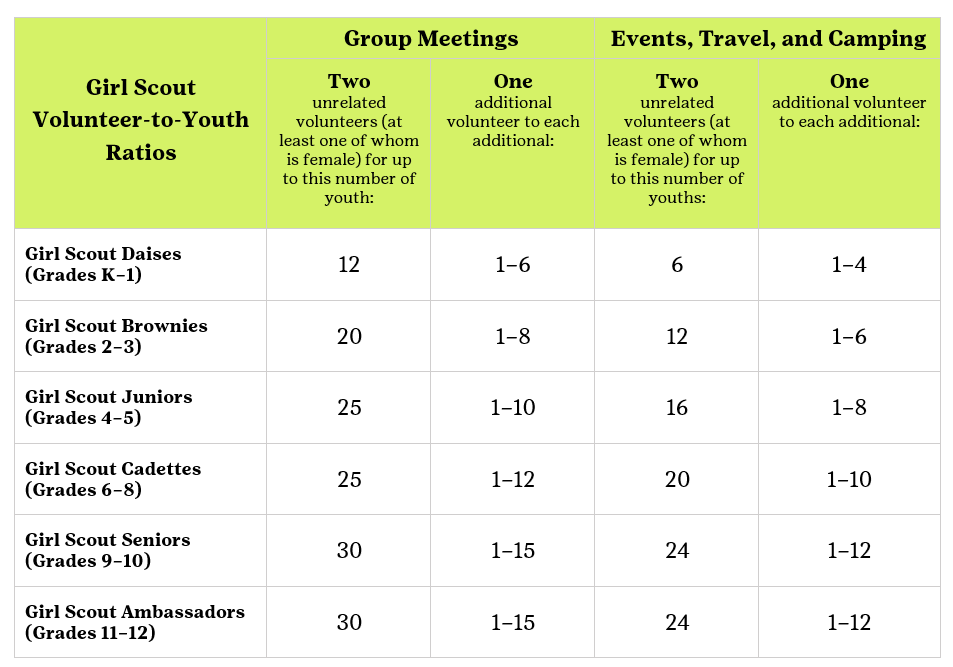
Click image to enlarge.
An embedded, screen-reader-friendly version of this table is available when this page is viewed on a desktop.
Safety in Girl Scouting
The emotional and physical safety and well-being of Girl Scouts is our top priority. Safety Activity Checkpoints outlines the Safety Standards and Guidelines used in Girl Scouting, which apply to all Girl Scout activities. Volunteers should refer to Safety Activity Checkpoints when planning Girl Scout-sanctioned activities.
For current COVID-19 guidelines, check our COVID-19 Protocols page.
In Safety Activity Checkpoints, you will find:
- Safety standards and requirements for adult supervision, transportation, permission slips, preparation for troop activities, and field trips and overnight trips.
- Individual safety checkpoints for specific activities—such as camping, internet use, and water sports—that provide activity-specific information.
- Specifics on activities not permitted by Girl Scouts of the USA and actions that Girl Scouts and volunteers should not take.
- Policies surrounding chartered aircraft trips and aviation.
- First aid and overall health information.
- Standards for well-being and inclusivity, and ways to include Girl Scouts with disabilities and to support everone’s emotional safety.
- Individual safety activity checkpoints for specific activities—such as camping, internet use, and water sports that provide activity-specific safety information.
The Buddy System
Use the buddy system anytime your troop leaves your meeting site or attends a field trip. Divide your troop into teams of at least two members, with each Girl Scout responsible for always staying with their buddy/buddies, warning them of danger, giving them immediate assistance if it’s safe to do so, and seeking help if needed. Girl Scouts are encouraged to stay near their buddy/buddies or join with another team, so that if someone is injured, one person cares for the injured party while others seek help.
Emergency Procedure Steps
These procedures apply to all leaders and volunteers with responsibility for girls and participants at official Girl Scout activities. It is very important that these steps are followed consistently in any emergency situation.
- Always have someone in the group as the designee to call 911.
- Remain calm.
- Give priority attention to providing all possible care for the injured.
- Secure emergency medical services and law enforcement as appropriate.
- Report the emergency immediately by calling the leadership center (210-349-2404 or toll free at 1-800-580-7247) at any time, 24 hours a day. By pressing #1, the automated phone system will forward the call directly to the emergency cell phone.
- In the event of fatality or serious accident, always notify law enforcement. Do not leave the scene of the accident until law enforcement arrives. If you must leave, retain a responsible person at the scene. Ensure that the victim and the surroundings are not disturbed until law enforcement has assumed authority.
- MAKE NO STATEMENTS TO THE MEDIA. Refer all media inquiries (press, radio, television) to GSSWT’s Marketing and Communications department. If no members of the department are available, take a message and inform them that someone will return their call. Do not discuss the incident, place any blame or accept liability.
- Keep record of all relevant conversations concerning the emergency.
- Complete and submit a Group Incident Report form to the Crisis Team Leader within 72 hours of the incident.
Registering Girls and Adults in Girl Scouting
Every participant (youth and adult) must register to become a member of Girl Scouts of the USA (GSUSA). GSUSA membership dues are valid for the Girl Scout membership year, which runs annually from October 1 through September 30. Membership dues cannot be transferred to another member and are not refundable.
Preregistration for the upcoming membership year occurs in the spring. Early registration allows for uninterrupted receipt of forms and materials from the council, helps troops and councils plan ahead, and gets members excited about all the great things they’ll do as Girl Scouts in the year to come. Note that a Girl Scout’s grade level is determined by the current membership year beginning October 1.
Lifetime membership is available to anyone who accepts the principles and beliefs of the Girl Scout Promise and Law, pays the one-time lifetime membership fee, and is at least 18 years old (or a high school graduate or equivalent). Volunteers with 10 or more years of service can become lifetime members at the discounted young alum rate.
Adding New Girl Scouts to Your Troop
Growing your troop is a great way to share the power of the Girl Scout experience! There are many ways to get the word out, like hanging posters in local schools, using social media to reach families in your community, and including your troop in your council's opportunity catalog or troop catalog.
For help registering your troop, contact our Customer Care team by calling 210-349-2404 (toll free 800-580-7247) or emailing customercare@girlscouts-swtx.org.
Creating an Atmosphere of Acceptance and Inclusion
Girl Scouts is for every girl, and that’s why we embrace Girl Scouts of all abilities and backgrounds with a specific and positive philosophy of inclusion that benefits everyone. Each Girl Scout—regardless of socioeconomic status, race, ethnicity, physical or cognitive ability, sexual orientation, primary language, or religion—is an equal and valued member of the group.
We believe inclusion is an approach and an attitude, rather than a set of guidelines. Inclusion is about cultivating environments that enable every Girl Scout to feel a sense of belonging. It’s about treating everyone with respect and dignity, and celebrating their unique strengths. It’s about being a sister to every Girl Scout. Some ways to cultivate inclusion and build belonging are to:
- Welcome every Girl Scout as a valued peer, and focus on building community. To start interactions off with care, learn each person’s name, caregivers included, with correct pronunciation. Use a warm and friendly tone, and consistently greet each community member when they arrive. Say goodbye to each person by name as well.
- Cultivate cooperation over competition, when appropriate.
- Cultivate a confidential, socially comfortable environment. Occasionally ask those who participate in Girl Scout programming if anything is worrying or bothering them. Be a trusted adult they can come to with their needs and emotions without judgment. Allow, but don’t require, participants to say the Pledge of Allegiance or the Girl Scout Promise and Law at meetings.
- Model respect for and understanding of all members and their families. Learn about the cultures and identities represented in your Girl Scout community, and honor cultural differences. Be sure not to put anyone on the spot or ask them to educate you about their culture/identity. Welcome personal sharing about people’s cultural traditions, spoken languages, and family structures. Make this kind of sharing a consistent, reliable part of your time together.
- Embrace diverse gender expressions and identities. Invite each community member to share their personal pronouns aloud or on name tags, explaining that no one has to share if they don’t want to. Make these conversations matter of fact and use a positive tone.
- Prioritize equitable communications, including feedback requests such as surveys, by ensuring consistent openness and reach to all members/families
- Learn the most valuable ways to support individual children and adults with disabilities, learning differences, and/or neurodivergence. Ask parents, "What can I do to support your child to participate/learn/feel successful in our group?"
To learn more about this topic, check out our Delivering Inclusive Program training on gsLearn.
If you have questions about accommodating an individual girl, please reach out to the council. Our Customer Care team is available to help you. You can reach us by calling 210-349-2404 (toll free 800-580-7247) or emailing customercare@girlscouts-swtx.org.
—that’s one in five people of every socioeconomic status, race, ethnicity, and religion.
Focus on Accessibility for All
A key part of creating an inclusive Girl Scout environment is making sure everyone is able to participate. As you think about where, when, and how often to meet with your group, consider the needs, resources, safety, and beliefs of all members and potential members. Seek to learn about the special needs of any members who have disabilities or whose parents/caregivers have disabilities—though don’t rely on visual cues to inform you. Disabilities include physical, sensory, and cognitive conditions, and not all of these are visible.
Approximately 20% of the U.S. population has a disability—that’s one in five people across every socioeconomic status, race, ethnicity, and religion. If you want to find out what an individual with a disability needs to make their Girl Scout experience successful, simply ask them or their parent/caregiver. If you’re open and receptive, they’ll likely respond in kind.
Remember, it’s important that all Girl Scouts be rewarded for their best efforts, not the completion of a task. Give everyone the opportunity to do their best, and they likely will! Sometimes that means changing a few rules or approaching an activity in a more creative way. Here are some examples of how to modify activities so that everyone can participate:
- Invite a member to complete an activity after they’ve observed others doing it.
- If an activity calls for using a sense that a Girl Scout doesn’t have (like sight for a Girl Scout who’s blind), find ways for them to participate using other senses. Can they touch objects and/or participate by hearing?
- If an activity calls for running, an individual who’s unable to run might walk if possible and desired by them, or perhaps move in another way.
To learn more, take our Delivering Inclusive Program course on gsLearn.
Language Related to Disability
First and foremost, seek personal preferences. How would the Girl Scout or family member you’re interacting with like you to refer to their disability (if at all)? When this information can’t be determined or you’re speaking more generally, consider taking a person-first approach—acknowledging the person first, then the condition or disability, or what a person has, not what that person is. So not "schizophrenic person," but "person with schizophrenia."
Still, know that there’s considerable disagreement here, with many in the disability community preferring an identity-first approach (e.g., "disabled person," not "person with a disability"), which reinforces the importance of establishing and honoring personal preferences whenever possible.
|
Say: |
Instead of: |
|
They have a learning disability. |
They are learning disabled. |
|
They have a developmental delay. |
They are mentally retarded; they are slow. |
|
They use a wheelchair. |
They are wheelchair bound. |
When interacting with a person with a disability that you’re aware of, keep the following guidance in mind.
- Speak directly to the person, not through a family member or friend.
- It’s okay to offer assistance to an individual with a disability, but wait until your offer is accepted before you begin to help. Listen closely to any instructions the person may have.
- Leaning on a person’s wheelchair is invading their space and should be avoided.
- When speaking for more than a few minutes to an individual who uses a wheelchair, place yourself at their eye level.
- When speaking to an individual who is deaf and using an interpreter, speak to them, not to the interpreter.
- When greeting an individual with a visual disability, always identify yourself and others. You might say, "Hi, it’s Sheryl. Tara is on my right, and Chris is on my left."
To learn more, take our Delivering Inclusive Program course on gsLearn.
If you want to find out what a girl with a disability needs to make her Girl Scout experience successful, simply ask her or her parent or caregiver. If you are open and honest, they’ll likely respond in kind, creating an atmosphere that enriches everyone.
It’s important for all girls to be rewarded based on their best efforts—not on the completion of a task. Give any girl the opportunity to do her best and she will! Sometimes that means changing a few rules or approaching an activity in a more creative way. Here are some examples of ways to modify activities:
Invite a girl to complete an activity after she has observed others doing it.
If you are visiting a museum to view a sculpture, find out if a girl who is blind might be given permission to touch the pieces.
If an activity requires running, a girl who is unable to run could be asked to walk or do another physical movement.
Focus on a person’s abilities—on what she can do rather than on what she cannot. In that spirit, use people-first language that puts the person before the disability.
Registering Members with Cognitive Disabilities
Girl Scouts with cognitive disabilities can be registered as closely as possible to their chronological ages. They should wear the uniform of the associated grade level. As a volunteer, you’re encouraged to make any adaptations to activities for Girl Scouts with cognitive disabilities.
These Girl Scouts may choose to retain their youth membership through their 21st year and then move into an adult membership category.
Getting Support for Your Troop
Just as your Girl Scouts rally around each other for support, you will also have a dedicated Girl Scout support team in the Community you are lcoated in, consisting of council staff and passionate volunteers like you. Your Community team is ready to offer local learning opportunities and advice as well as answer your questions about the Girl Scout program, working with girls, product sales, and much more.
Before you hold your first troop meeting with girls, consider the support and people resources you’ll need to cultivate an energizing troop experience. Parents, friends, family, and other members of the community have their own unique strengths and can provide time, experience, and ideas to a troop, so get them involved from the very beginning as part of your volunteer troop team. This team is made up of troop leaders (like you) and troop committee volunteers.
Your troop committee volunteers are the extra set of eyes, ears, and hands that help the troop safely explore the world around them. Depending on your troop’s needs, they can play a more active role—for instance, someone can step up as a dedicated troop treasurer—or simply provide an occasional helping hand when you need to keep a meeting activity on track.
If a parent or caregiver isn’t sure if they can commit to a committee or co-leader role, encourage them to try volunteering in a smaller capacity that matches their skill set. Just like your young Girl Scouts, once troop parents and caregivers discover they can succeed in their volunteer role, they’ll feel empowered to volunteer again.
Troop Management Tools and Resources
From toolkits and guides to regular contact with experienced individuals, you’ll have all the support you need to be a Girl Scout volunteer.
You’ll find tools to keep your troop going strong on MyGS, which you can always access via the icon on the upper right corner of our website. Click/tap the “login” button, then “my account”—you’ll see the gsLearn and VTK buttons on the left menu bar, accessible on any desktop, tablet, or mobile device. The menu bar will be populated with any trainings you should view.
Here are some important resources you’ll want to be sure to check out.
The Volunteer Toolkit
The Volunteer Toolkit is a customizable planning tool where you can find suggested meeting plans for most badges, access activity guides, track your Girl Scouts’ achievements, and so much more. Featuring inspiring ideas for engaging your troop in a mix of activities all year long, it’s the digital planning assistant that will help you power a fun-filled—and organized—Girl Scout year.
With the Volunteer Toolkit, girls and leaders can explore meeting topics and program activities together and follow the fun as they plan their Girl Scout year. Using the Volunteer Toolkit:
Troop Leaders can:
- Plan the troop’s calendar year and meeting schedule.
- Email parents/caregivers with one click.
- View the troop roster, renew girls’ memberships, and update girls' contact information.
- View meeting plans for Journeys and badges, including suggested tracks for multi-level groups (K–5 and 6–12).
- Customize meeting agendas to fit your troop.
- Explore individual meeting plans that show a breakdown of every step, including a list of materials needed, editable time allotments for each activity within a meeting, and printable meeting aids.
- Record attendance at meetings and their troop’s badge and Journey achievements.
- Add council or custom events to the troop’s calendar.
- Submit troop finance reports (depending on the council’s process).
- Easily locate both national and local council resources, such as Safety Activity Checkpoints.
Parents and Caregivers can:
- View the troop’s meeting schedule and individual meeting plans to stay up to date on the badges and Journeys the troop is working on.
- Renew their memberships and update their contact information.
- View their Girl Scout’s attendance and achievements.
- See upcoming events the troop is planning or attending.
- Easily locate both national and local council resources.
- View the troop’s finance report (depending on the council’s process).
gsLearn
gsLearn is our online training platform that gives you easy access to online and in-person learning opportunities as well as the ability to track all your accomplishments! Learn at your own pace, access additional resources, and repeat trainings as needed!
To access gsLearn, first log in to MyGS. You’ll find the platform in the options on the left-hand navigation bar.
More Tools and Resources
Girl Scout handbooks. These grade level-specific handbooks break it down for your Girl Scouts. Adventures include earning badges and awards, running a cookie business, and learning about the traditions that have brought Girl Scouts together for over a century.
Safety Activity Checkpoints. Safety is paramount in Girl Scouting, and Safety Activity Checkpoints contains everything you need to know to help keep everyone safe during various activities done outside of regular Girl Scout troop meetings.
Tips for Troop Leaders. When you’re looking for real-world advice from fellow troop leaders who’ve been there/done that, this volunteer-to-volunteer resource has what you need for a successful troop year.
Troop year plans. Our grade-level-specific troop year plans are the best tool for first-year troop leaders getting started with Girl Scouts, or to help any troop leader in planning out a well-balanced Girl Scout year. The entire year is mapped out—just follow along to help your Girl Scouts complete badge activities, improve their communities, and explore the world around them.
Girl Scout volunteers in your community. Remember that Girl Scout support team we mentioned? You’ll find it in your service unit! Troops are organized geographically into service units or communities, which are local networks of fellow leaders and administrative volunteers ready to offer tips and advice to help you succeed in your volunteer role.
Customer Care Contacts
Questions? Need help resolving an issue? We’ve got you! Reach out anytime by completing the form on the Contact Us page or email customercare@girlscouts-swtx.org. During business hours, you can reach a Customer Care Specialist by calling 210-349-2404 (toll free 800-580-7247).
Safety Activity Checkpoints. Safety is paramount in Girl Scouting, and Safety Activity Checkpoints contains everything you need to know to help keep everyone safe during a variety of exciting activities outside of their regular Girl Scout troop meetings.
Tips for Troop Leaders. When you’re looking for real-world advice from fellow troop leaders who've been there, this volunteer-to-volunteer resource on the Girl Scouts of the USA website has what you need for a successful troop year.
Troop Year Plans. Our age-appropriate troop year plans are the best tool for first year troop leaders to get started with Girl Scouts without getting overwhelmed, or to help any troop leader with planning out a well-balanced Girl Scout year. The entire year is mapped out—just follow along to help your Girl Scouts complete badge activities, improve their communities, and explore the world around them. Access Troop Year Plans online here!
Girl Scout Volunteers in Your Community. Remember that Girl Scout support team we mentioned? You’ll find them in your service unit! Troops are organized geographically into service units or communities. You’ll find a local network of fellow leaders and administrative volunteers ready to offer tips and advice to help you succeed in your volunteer role.
Even More Learning Opportunities
We know that when you have the knowledge and skills you need to manage your Girl Scouts, both you and your troop thrive. We offer national onboarding training for new troop leaders, to combine with local training courses provided by your council.
What Girl Scouts Do. This course introduces what Girl Scouts do at each grade level and how they do it, helping you plan your troop’s year. Take the course.
Your First Troop Meeting. This course provides new troop leaders with the structure and tools to plan a successful first troop meeting?and beyond?with their Girl Scout troop. Take the course.
The Girl Scout Leadership Experience (GSLE). This course teaches you how to implement the Girl Scout Leadership Experience—the framework that sets Girl Scouts apart—in an age-appropriate way for your troop. Take the course.
Family Engagement: The Key to Success. This course highlights the value of family engagement and provides practical strategies for how to enlist family support. Take the course.
The Girl Scout Cookie Program. This course reviews the basics of the Girl Scout Cookie Program, including why Girl Scouts sell cookies, who the cookie bakers are, how to use your cookie proceeds safely with your troop and with support from parents/caregivers. Take the course.
Troop Safety. This course equips you with the fundamentals to keep your troop safe in meetings and on field trips. You’ll also learn about a go-to guide that helps your troop stay safe no matter where your adventures take you! Take the course.
Funding the Fun. Explore the basics of managing your troop?s funds, including how troops fund meetings and activities, and manage and report their finances to their councils. Take the course.
These courses are available online via gsLearn as referenced above. Your council may offer local onboarding training for new troop leaders, as well as other ongoing training opportunities. Contact your council to ask about additional training opportunities that will help you grow your skills and confidence.
Other Program Courses
Leading Multi-Level Troops. Multi-level troops provide unique opportunities for Girl Scouts and their families. This course provides tips, tools, and strategies for leading a multi-level troop through an exceptional Girl Scout experience. Take the course.
Field Trips and Travel. This course guides you in planning a Girl Scout trip. It also covers the concept of Girl Scout travel progression. Take the course.
Sexual and Child Abuse Prevention. Child abuse and neglect are difficult subjects to think about, yet the prevention of abuse is a topic Girl Scouts takes—very seriously. This training prepares supervising adults of Girl Scout youth to recognize, respond to, and report concerns of child abuse and neglect. Take the course.
Delivering Inclusive Program. In this course, you’ll practice using inclusive language to support Girl Scouts of all backgrounds and identities and foster a cohesive troop environment. Take the course.
Courses are also offered about specific badges, including Math in Nature and Mental Wellness, as well as Daisy petals.
Newsletters, Communication, and Social Media
We have four easy ways for you to stay up to date with GSSWT:
- Website: This website is the place to find everything you need to know about what’s going on with GSSWT.
- Girl Scouts of Southwest Texas Newsletter: A monthly e-newsletter sent directly to your email with highlights on what’s going on in the council.
- Girl Talk, a quarterly publication mailed to your home with an overview of council events.
- Social media: Connect with us on Facebook, Twitter, Instagram, YouTube, and LinkedIn.
We encourage our members to connect with us on social media for the latest news about GSSWT and as a place to share your own news about your Girl Scouts and what they’re accomplishing. You can find links to our accounts at the bottom of this website.
Below are a few guidelines to follow when participating in social media:
- Be friendly and respect others. Don’t use social media to attack other volunteers, troop members, or staff members. Don't be mean, call people names, use racial slurs and/or foul language.
- Be courageous and strong. Careful monitoring of social media is important in maintaining a welcoming and supportive community. If you see posts, comments, or behavior that concerns you, please notify us. Don’t be afraid to speak up or ask questions.
- Tell your story. Add value by saying something helpful, witty, or informative. Show how your Girl Scouts are making the world a better place.
- Be responsible for what you say and do. Remember that what you post online will be around for a long time, and nothing is private anymore. Use discretion.
- Be cautious. Do not publish girls’ full names online—girl safety is a top priority!
- Respect authority. If your actions on social media—as with any other kind of actions taken as a Girl Scout volunteer—do not support the Girl Scout Promise and Law, we do reserve the right to take corrective action.
- Speak for yourself. We know your opinions may not always be the same as the council's. Just make sure that your presence in the social media world is in the first person-lots of "l" and not much “we.”
- Use common sense. Think of social media as a giant worldwide billboard. What you post can be seen by anyone—your boss, your co-workers, and your mom. You don't need a poorly chosen Tweet to wreak havoc on the council or your life.
As a representative of Girl Scouts, your online presence can reflect positively or negatively on Girl Scouts. It is always recommended to set your personal Facebook profile to “private” (only your Facebook friends can see it), especially if you have Girl Scouts of Southwest Texas listed as an organization that you volunteer for or represent. Please remember that your Facebook profile picture can always be viewed publicly, so use discretion when choosing how the world sees you.
Facebook Groups
The main Girl Scouts of Southwest Texas Facebook page is the best place to stay connected with what’s going on in the council. For a deeper dive into events, as well as conversations with fellow parents and volunteers, we have several Facebook groups connected to our page. They are:
- GSSWT Volunteers: This is the main volunteer group where you can find information about council events, office updates/closures, etc.
- West Side Girl Scout Leadership Center: This group is where you can find information about events happening at our West Side center.
- GSSWT Daisies-Juniors: Use this group to connect with other volunteers, troop leaders, and parents with girls in the Daisies, Brownies, and Juniors grade levels.
- GSSWT Cadettes-Ambassadors: Use this group to connect with other volunteers, troop leaders, and parents with girls in the Cadettes, Seniors, and Ambassadors grade levels.
Rallyhood
Rallyhood is an online community collaboration platform that allows community leadership team members and co-leaders to communicate about community events, share information, post announcements and photos. Watch for your email invitation to Rallyhood. Missing your email invite to this valuable resource? Contact our Customer Care Department at customercare@girlscouts-swtx.org for assistance.
Resource Center
The Resource Center at the Sally Cheever Girl Scout Leadership Center has been developed for you, the Girl Scout volunteer. Whether you are an experienced or new volunteer, you want the right resources when you need them.
The Resource Center loans items such as flags, ceremony and program supplies, camping and sports equipment, books, badge kits and more to assist adults in providing Girl Scout program to girls. You’ll find a laminator, die-cut machine, copier, comb binding machine, along with assorted office equipment to put your posters, projects, and other program activity resources together. Knowledgeable staff are available in person or by phone to assist you.
Girl Scout Participation in Activities with Other Scouting Organizations
The decision by Boy Scouts of America (BSA) to open the Boy Scout program to girls has fundamentally altered the nature of the relationship between BSA and Girl Scouts nationally and locally. Local relationships between BSA and Girl Scout councils that have led to partnerships and joint activities in the past may now create certain risks or challenges for Girl Scouts. For this reason, councils are encouraged to avoid joint recruiting and/or joint participation in community events or activities.
Marketplace Confusion
To protect the integrity of the Girl Scout brand and reinforce our programming as unique, girl-only, and best in class, we must ensure that we take care that the activities in which our members participate are exclusive to the Girl Scout program, are safe and girl-led, and are conducted under the appropriate supervision of Girl Scouts.
Protecting Use of Girl Scout Materials
Girl Scout materials are intended for the exclusive use of Girl Scouts and are protected as the intellectual property of Girl Scouts of the USA. Materials include but are not limited to: Girl Scout logo, tag lines, and/or program and badge requirements.
© Copyright 2009–2026 Girl Scouts of the United States of America. All rights reserved. All information and material contained in Girl Scouts’ Volunteer Essentials guide (“Material”) is provided by Girl Scouts of the United States of America (GSUSA) and is intended to be educational material solely to be used by Girl Scout volunteers and council staff. Reproduction, distribution, compiling, or creating derivative works of any portion of the Material or any use other than noncommercial uses as permitted by copyright law is prohibited, unless explicit, prior authorization by GSUSA in writing was granted. GSUSA reserves its exclusive right in its sole discretion to alter, limit, or discontinue the Material at any time without notice.
